
ITS News 01/2026
Organizational changes at the ITS
Campus IT & Research Data Support from 2026
Starting in 2026, the User Support department and the ResearchData@ITS team will merge to form the new organizational structure: Campus IT & Research Data Support.
What will change during the year?
The existing services—Help Desk (Anlaufstelle), PC Garage, and Laptop Consultation—will be consolidated into the central Campus IT Support. Our goal is to pool resources, distribute tasks more effectively, and simplify communication for everyone involved through transparent and clearly defined structures.
On-site at the ITS, the Service Point in the entrance area will serve as your primary point of contact. If you encounter issues setting up services such as eduroam or VPN despite using our online guides, you can receive in-person assistance during opening hours without an appointment.
The ITS Helpdesk will handle all incoming inquiries—whether via email, support form, telephone, or in person. Your requests will be documented and either processed directly or forwarded to the appropriate technical support, software support, or relevant specialist departments.
Technical Support provides UBT employees with hardware consulting, installations, fault analysis, repair coordination, and the professional disposal of university-issued devices. For students, the services previously offered by the PC Garage will remain available.
OS & Software Support offers assistance with Apple and Microsoft systems as well as M365 services. Furthermore, we continue to manage procurement and license management for software under UBT central and framework agreements.
The new structure will also be reflected in the physical layout: The Service Point will be located in room 3.2.U1.132 of the ITS. Meanwhile, the ITS Helpdesk and Technical Support teams will work together in the central rooms of the former Help Desk (3.2.U1.1.161 – 163).
What does this mean for you?
This reorganization is a vital step toward making our services more efficient, user-friendly, and future-proof. We look forward to continuing our support for colleagues and students while breaking new ground in service quality and improvement.
Your familiar Campus IT Support team—Martin Weydenhammer, Christopher Heimler, Jörg Teichmann, and Markus Wagner—will be joined by our two newest team members, Tanja Voigt and Michael Schichwarg.
Campus-IT-TIPS
Make the most of existing information and communication channels:
- Guides & Tutorials: Our guides cover UBT-specific topics, such as the ITS Portal or mapping network drives. We also provide comprehensive online tutorials with practical tips, files, and tools to help you independently set up and use eduroam, VPN/Proxy, FollowMe-Printing, and Office365.
- ITS AI Chatbot: Available 24/7, regardless of the day or time: Our chatbot provides quick assistance for simple questions by using the public ITS webpages as its information source. If an answer isn't quite right, no problem: the chatbot can automatically generate an inquiry via our support form upon request.
- Support Form: You can find the link to our support form at the bottom of every ITS webpage. By selecting the appropriate support category, your request is sent directly
- Email: Inquiries sent via email to its-helpdesk@uni-bayreuth.de go directly to the ITS Helpdesk. If necessary, they will be forwarded to the appropriate specialist departments.
- Telephone - Picking up the phone as a last resort: If your inquiry concerns media technology, please use the multimedia hotline at 0921 55 2002. The ITS Helpdesk telephone hotline is unfortunately currently unavailable due to technical problems and staff shortages. Inquiries can only be made here via the support form or by email.
- WebShop Orders: If you have any uncertainties regarding your WebShop order, we are here to help. We are happy to advise you personally—please use our support form or send us an email.
New Digital Learning Hubs on Campus
The media infrastructure has been further expanded and modernized by the ITS’s dedicated Media Technology Team – a significant step toward future-oriented, digitally supported university teaching.
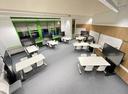
Digital Learning Space – The Interactive Learning Environment
The Digital Learning Space (S74, NWII) is a prime example of innovative learning environments. Based on the Scale-Up concept, it promotes active, collaborative learning. Five 55-inch touch displays allow for parallel group work. With central media technology, such as the Cynap Pro and several Cynap Core Pro stations, presentations can be shared wirelessly – directly from the students' own devices. The room is currently being expanded: two additional workstations and two large-format presentation displays are being added. Content can be mirrored across all displays via the central Cynap Pro hub – ideal for discussions, comparisons, and presentations. More information:
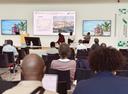
FZA – The Event Space with LED Wall
The FZA stands out with its large-scale LED wall, enabling high-quality presentations. The new technology, based on Crestron AV over IP, offers flexible input points – perfect for hybrid events and complex presentation scenarios.
DMX lighting control provides variable illumination, supported by a
powerful audio system and numerous microphones that ensure clear sound
transmission both in the room and online.
H23 – Intelligent Camera Tracking for Optimal Presentations
In lecture hall H23, the entire media technology has been renewed.
The Q-SYS camera tracking system automatically detects the person speaking and aligns the cameras accordingly – controlled via Sennheiser ceiling microphones. Instructors benefit from a one-cable solution: a single USB-C interface provides access to cameras, audio, network, power, and video transmission.
Further Modernizations on Campus
In addition to these highlights, there have been other important improvements:
15 Cynap systems have been upgraded to strengthen digital teaching.
24 outdated projectors with mercury lamps were replaced by sustainable, energy-efficient laser projectors.
Numerous rooms, such as the Spielhalle, S102, S103, H21, H22, H6, H36, H20, H19, H16, H17, H27, S145–147, the Open Innovation Lab, the Idea Lounge, the Project Studio, the RW Foyer, and the Edulab, received comprehensive media technology upgrades.
These measures create a homogeneous, state-of-the-art technical infrastructure that benefits both instructors and students. Instructors work with user-friendly, modern systems, while students benefit from clear image and sound quality as well as improved interaction possibilities.
The Future of Teaching: Networked and Interactive
Given the increasing connectivity and rising demands for video conferencing, meeting and department rooms are also increasingly being planned and equipped with media technology. The university is ready for the digital future!
High-Performance Computing at the University:
Awarded the 2025 Emil Warburg Technology Prize
Digitalization and technological progress have fundamentally transformed the world of science. Without High-Performance Computing (HPC), modern research in many disciplines would be almost inconceivable today. For his work in the field of HPC, René Meißner, a member of the IT Servicecenter (ITS) at the University of Bayreuth, has been honored with the 2025 Emil Warburg Technology Prize.
Together with his colleague Bernhard Winkler, René is responsible for the maintenance and configuration of the high-performance computing clusters at the University of Bayreuth.
The highlight of his work to date was the establishment of the new computing cluster "Festus." He procured the necessary components, organized the hardware setup, and configured the entire system. The result is impressive: the new computing cluster was completed in significantly less time than its predecessor and runs with exceptional stability, reliability, and high performance.

Through dedication and technical expertise, available resources are being utilized to their full potential. His work creates added value for the entire university, enabling researchers to implement their projects efficiently and successfully. Many scientific breakthroughs and innovations would not be possible without a reliable IT infrastructure.
The presentation of the 2025 Emil Warburg Technology Prize recognizes René Meißner's commitment and outstanding achievements.

Ein Projekt ist nur so stark wie das Team, das es umsetzt. Die Zusammenarbeit (unter anderem mit der ZT, der Netzwerkabteilung oder den Testnutzern) und der Austausch von Ideen und Erfahrungen sind entscheidend für den Erfolg.
René Meißner
René, what were the greatest challenges in setting up the new computing cluster?
René Meißner: Keeping track of the numerous details and dependencies was definitely a challenge. The spontaneous delivery of over 40 nodes, which had to be hastily stored and installed, didn't make things any easier. :)
How did you decide to manage the project independently?
Our department head, Günther Neubauer (also known as "Festus"), asked if we could purchase a system through the framework agreement. I liked the idea... By purchasing through the framework agreement, we were able to avoid a risky formal tender process. As a result, I discarded the nearly finished tender documents and opted for the framework agreement instead. The desire for maximum creative control over the hardware selection and configuration essentially turned the project into an "in-house build." This allowed us to save on costs and invest more in pure computing power.
Was there anything that didn’t go as planned?
A few things. The deliveries arrived earlier than expected, but some configurations took much longer than anticipated.
The scripts and programs in the accounting area took a long time to reach maturity. However, I learned a lot, and building the successor should go much more smoothly.
How do you see the future of High-Performance Computing at the University of Bayreuth?
We will continue to increase our CPU time capacities. In the long term, we should look for solutions that make better use of the waste heat generated by servers. This doesn't just apply to HPC, but to the university's IT systems in general. Unfortunately, there is a visible trend where people use funded equipment for free while simultaneously using their own funds to build separate, individual systems. This is neither organizationally sustainable nor economically or ecologically sensible. I would like to appeal to the community spirit of decision-makers to contact the ITS/KeylabHPC to check whether their requirements can be met by strengthening a central system instead. This would be a win-win for everyone involved. A great way to stay up to date on current developments is to join the BZHPC.
Dates & Events
- Monday, Feb 23, 2026 / 9 a.m. – 11 a.m. / AI Training
- Wednesday, Mar 4, 2026 / 9 a.m. – 11 a.m. / AI Training
- Monday, Mar 23, 2026 / 9 a.m. – 11 a.m. / AI Training
AI-supported image and text editing. Registration is available through the respective courses in the e-learning system.

LEGAL NOTICE / IMPRINT
Publisher: IT Servicecenter (ITS) University of Bayreuth Universitätsstraße 30 95447 Bayreuth, Germany
Editor-in-Chief: Oliver Gschwender
Authors: Nadja Bursian, Dr. Thomas Martin, Dominik Schramm, René Meißner Design: Nadja Bursian
Photos: Dominik Schramm, Nikolai Jahreis, Adobe Stock